
Two soils, one city
Hydroseeding in Austin, TX
Seed, hydromulch and erosion control matched to which side of the fault your lot is on.
- Free on-site measuring and a written, itemized quote
- Seed picked for your soil: Hill Country rock or Blackland clay
- Erosion and silt fence work planned around TCEQ and city rules
Seeding a City That Sits on a Fault Line
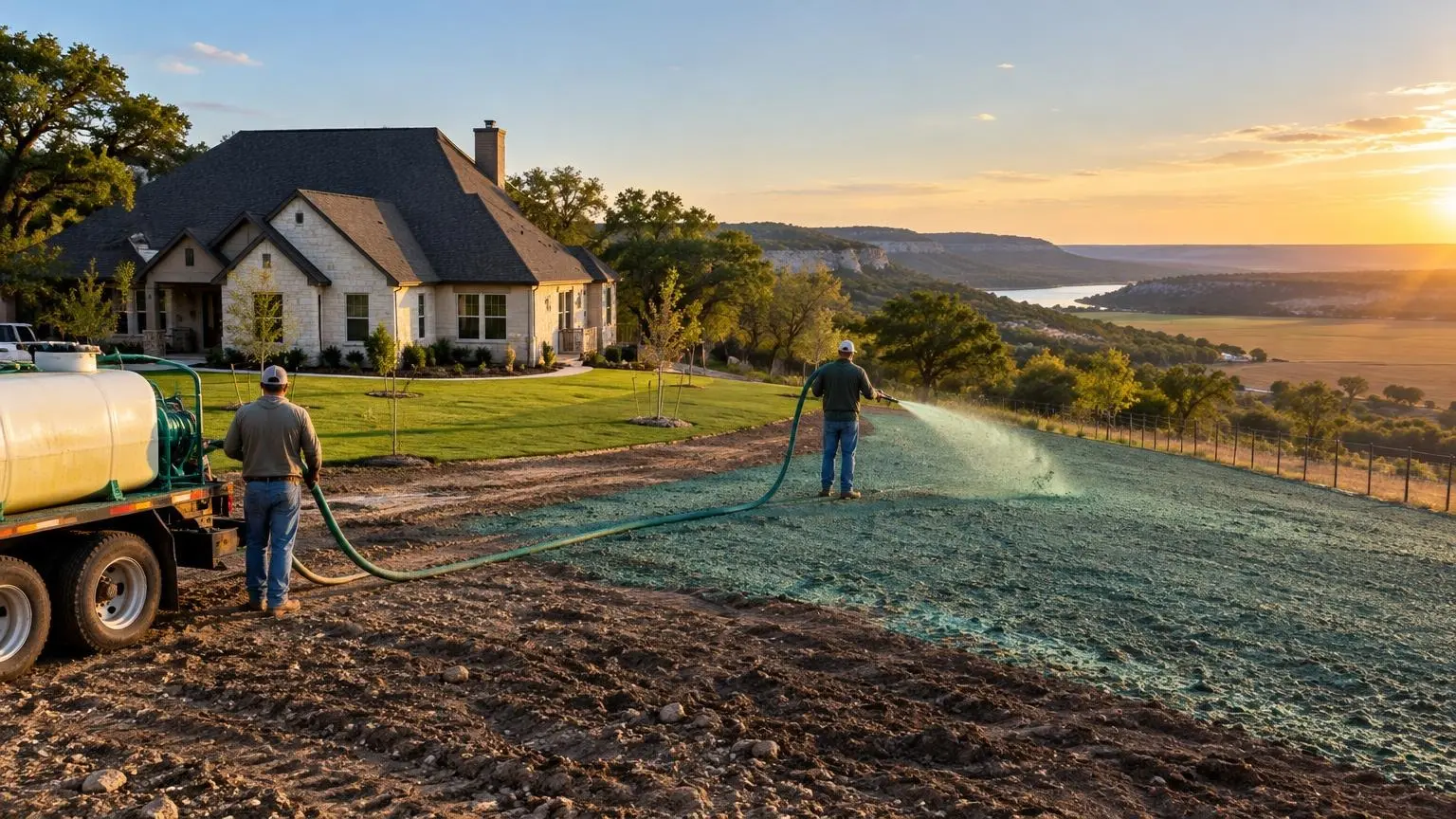
Hydroseeding in Austin starts with one question: which side of the Balcones Fault is the job on? The city straddles it, and the ground changes fast. East Austin is mostly flat, with heavy clay and loam soils. West Austin rises into the rolling limestone hills at the edge of the Hill Country, where the rock often has only a thin covering of topsoil. A mix and a seed rate that work in Mueller or Del Valle can wash straight off a cut slope in Westlake.
East side: clay that moves
The deep clays on the east side include types with pronounced shrink-swell behavior, and many are slightly to moderately alkaline with free calcium carbonate. They are hard to work when wet and crack when dry. For a hydroseed lawn here we fine grade to shed water away from slabs, avoid working the soil when it is sticky, and keep the slurry on the surface where the seed can touch soil instead of sitting on dried clods.
West side: thin soil over rock
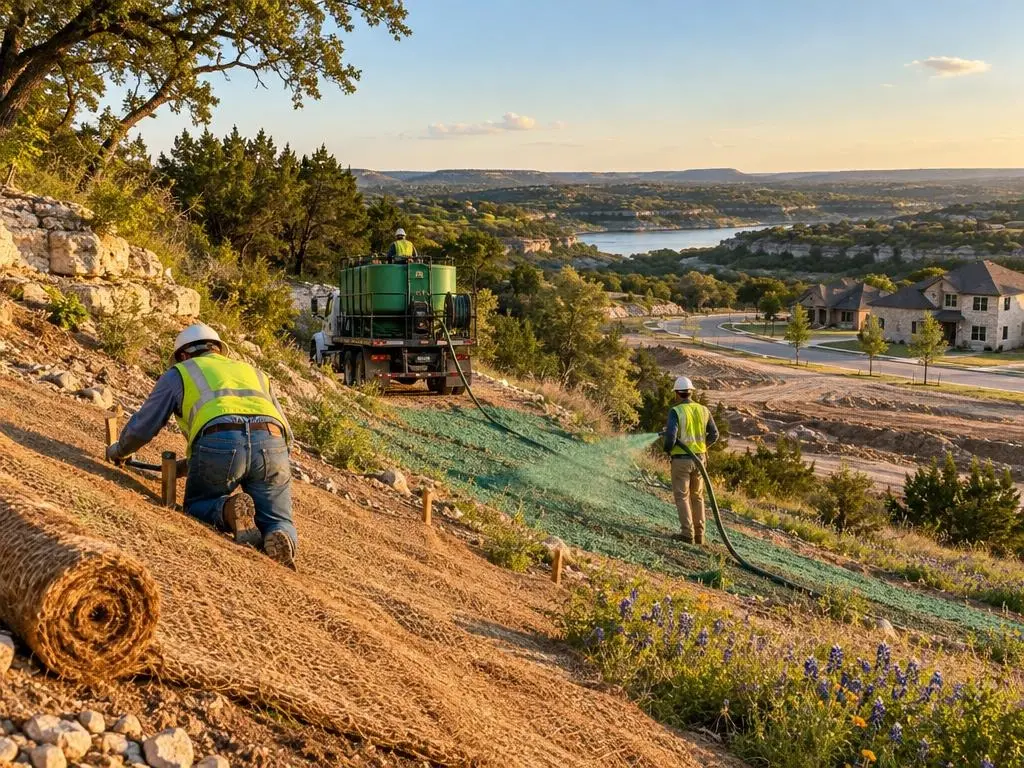
On the limestone side, a few inches of topsoil over rock is common. Grass roots run out of room quickly, and runoff from a summer storm moves fast. That is why the city sees flash flooding after heavy thunderstorms. On these lots we usually bring in topsoil before seeding, and on steeper ground we switch from standard hydromulch to a heavier bonded fiber matrix or straw erosion control blankets.
Timing the seed
Austin averages a 288-day growing season, with the average first and last freezes around December 1 and February 15. Highs reach 90 F or more on about 123 days a year. Warm-season grass seeded in spring or early fall gets the longest run of good weather before July heat. Spring and fall are also the wettest seasons, which helps germination but means silt fence and inlet protection need to be in before the rain, not after.
Mud in the lakes
In October 2018, after flooding upstream, the Highland Lakes that supply the city's water were overwhelmed by silt, dirt and debris, and Austin went under a citywide boil-water advisory for a week. Covering disturbed ground quickly with hydromulch is one of the cheapest ways to keep soil on site.
What Austin jobs usually need
- New lawn installation after a build or remodel
- Hydroseeding and silt fence on commercial and subdivision sites
- Slope stabilization on west-side cuts
- Yard grading and topsoil on thin-soil lots
- Lawn renovation and overseeding on tired turf
Tell us the address and roughly how much ground is bare, and we will tell you which approach fits. Get a free estimate or call (737) 271-9852.
Austin Ground Conditions
- Soil range. Austin soils run from shallow, gravelly clay loams over limestone on the western outskirts to deep sandy loams, silty clays and clays in the east, some with strong shrink-swell.
- Growing season. The average growing season is 288 days, with first and last freezes around December 1 and February 15.
- Rainfall. Austin averages 34.32 inches of rain a year, with spring and fall the wettest seasons.
- Flash floods. Because the western hills are limestone with thin topsoil, parts of the city are often hit by flash floods from thunderstorm runoff.
- 2018 silt event. In October 2018 silt and debris washed into the Highland Lakes, triggering a week-long citywide boil-water advisory.
Austin Questions
Does it matter if my house is east or west of MoPac?
It often does. East-side lots tend to be clay that swells and cracks, while west-side lots are often thin soil over limestone. We adjust grading, topsoil and mulch type to the ground we find.
How soon after a build can you hydroseed?
As soon as final grade is set and the trades are off the lawn area. Seeding before landscaping crews finish usually means repairing tire ruts later.
Will hydroseed survive an Austin summer?
It can if it is seeded with enough lead time and watered on schedule. Seeding in spring or early fall gives the roots a head start before the long run of 90 degree days.
Can you handle silt fence for a city-permitted site?
Yes. For Austin construction sites we put in silt fence, inlet protection and hydromulch, and we can follow your erosion control plan sheet.
Free Estimates in Austin, TX
Free estimates anywhere in Austin, east or west.
Hydroseeding Near Austin
- Hydroseeding in Round Rock, TX
- Hydroseeding in Cedar Park, TX
- Hydroseeding in Leander, TX
- Hydroseeding in Georgetown, TX
- Hydroseeding in Pflugerville, TX
- Hydroseeding in Hutto, TX
- Hydroseeding in Taylor, TX
- Hydroseeding in Elgin, TX
- Hydroseeding in Manor, TX
- Hydroseeding in Bastrop, TX
- Hydroseeding in Kyle, TX
- Hydroseeding in Buda, TX
- Hydroseeding in San Marcos, TX
- Hydroseeding in Wimberley, TX
- Hydroseeding in Dripping Springs, TX
- Hydroseeding in Lakeway, TX
- Hydroseeding in Lago Vista, TX
- Hydroseeding in Jonestown, TX
- Hydroseeding in Marble Falls, TX
- Hydroseeding in Lockhart, TX